Thursday, May 7, 2009

The Seventh Day of May


The First Adorer of the Incarnate Word.

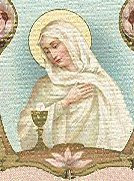
Behold, behold my model, my Mother, Mary, the first adorer of the Incarnate Word in her womb. how perfect must this adoration of the Virgin Mother have been in itself, how pleasing to God and how rich in graces!

What ought to have been the perfection of Mary’s adoration at the first instant of the Incarnation?

I.

An adoration of humility, of annihilation before the Sovereign Majesty of the Word, at the sight of the choice He has made of His poor handmaid, under the weight of so much goodness and love for her and for men. Such ought to be the first act, the first sentiment of our adoration after Holy Communion. Such was Elizabeth’s sentiment when receiving the Mother of God, who was bringing to her the Savior still hidden in her womb. Unde hoc mihi? Whence comes to me this happiness which I so little deserve? It is the word of the centurion, also, at whose house Jesus chose to sojourn: Lord, I am not worthy!

II.

The second of Mary’s acts of adoration should naturally be an act of joyous gratitude for God s ineffable and infinite goodness to men, an act of humble gratitude for His having chosen this unworthy, but thrice happy, handmaid for the reception of so signal a grace. Her gratitude breathed forth in acts of love, of praise, of thanksgiving. She exalts the Divine Goodness. Gratitude is an out pouring of the soul in the person benefitted, a great and loving expansion of the soul. Gratitude is the heart s love.

III.

The third act of the Blessed Virgin’s adoration had to be one of devoted- ness, the offering of self, the gift of self and of her whole life to the service of God: Ecce ancilla Domini; also an act of regret for being so little, for having so little, of being so incapable of serving Him worthily.

She offered herself to serve Him in whatever way He willed, by all the sacrifices that He might be pleased to exact of her, too happy to be able to please Him at any price, thus to respond to His love for men in His Incarnation.

IV.

The last act of Mary’s adoration was, doubtless, an act of compassion for poor sinners, for whose salvation the Word became incarnate. She knew how to excite His infinite mercy in their favor. She offered herself to repair for them, to do penance for them, in order to obtain their pardon and return to God. She begged for them the happiness of knowing their Creator and their Savior, of loving and serving Him, thus rendering to the Most Holy Trinity the honor and glory due from every creature, but above all from man, the tender object of the love and mercy of a God so great and so good. that I could adore Our Lord as that good Mother adored Him, for I possess Him as she did, in Holy Communion!

O my God, hearken to the great, the important petition that I now make Thee! Give me the Most Blessed Virgin Adoratrix as my true mother. Let me share in her grace, in that state of uninterrupted adoration in which she was during the whole time that she bore Thee in her pure womb, that paradise of virtue and of love.

I feel, my God, that would be one of the greatest graces of my life. I desire henceforth to adore in union with that Mother of adorers, the Queen of the Cenacle.

Practice: Make faithfully, and in union with Mary, your thanksgiving after Holy Communion.

Aspiration: Mary, I have received thy well-beloved Son, and I shall never let Him go!

Wednesday, May 6, 2009

The Sixth Day of May


The Annunciation.

Reflecting on the circumstances of the mystery of the Annunciation, we discover in Mary the most sublime qualities. What glory for her to have been called to take part in the work of the Incarnation of the Word, the grandest of the divine works! And what virtues her example teaches us!

I.

An archangel is deputed by God, an archangel of the divine power comes on the part of God to treat with a creature. It is the most important mission ever fulfilled by a heavenly messenger. The angel descends from heaven full of glory, beautiful as a star, flooded with rays of the Divinity.

To whom does he go? Ah! had the world known of the celestial messenger’s coming to earth, it would have sought among the rich and the powerful for the happy mortal to whom he bore the grand message, because the world willingly believes that perfection is found in greatness. But the angel goes to a virgin of fifteen, humble and unknown, legally espoused to a poor artisan, dwelling in a poor home, in a town despised and ignored. He goes to Mary! What! so much preparation for this unknown maiden! Yes. Worldly prestige soon comes to naught and human pride is confounded. We see only what shines, we value only gold and diamonds. Ah! at the General Judgment they will be trodden under foot like vile stones, and hell will be paved with them.

The angel goes to a virgin. God admits only pure souls to intimacy. He pardons the sinner, but He unites Him self only to purity.

The angel is the first to salute. He is, indeed, the less worthy of the two. Mary is sovereign here, and since the Three Divine Persons are awaiting an answer, she holds in her hands the fate of the world. Ah, how powerful is that lowly maiden!

Hail, full of grace!—Among all the daughters of Eve, Mary alone is full of grace. We are full of the miseries of original sin. Mary is pure as the sun. God formed her of special earth, and fashioned her with singular care.

The Lord is with thee.—Yes, for He dwells in the purity of thy heart, Mary, as in a paradise of delights, and thy virtues are so many flowers that send up to Him the sweetest perfume. At what hour did the angel appear? The Gospel does not say. Commentators think that it was about midnight, at the moment that one day ends and another begins, for Mary is the aurora which separates darkness from light. She was at that moment in prayer. She was sighing for the coming of the Messiah. We may suppose this without fear of being deceived, for God ordinarily gives to souls a prayer conformable to the grace that He designs to bestow upon them, and which prepares them for it. Let us at that solemn hour of the conception, and later at the birth of the Son of God, made flesh, pray with Mary, and in union with her adore the God who be came incarnate for us.

II.

Mary was troubled.—It is characteristic of virgins, says St. Ambrose, to be troubled at the approach of a man, and to fear his words. Mary was troubled, also, at the praise addressed to her, although she well deserved it. But true virtue never recognizes itself.

The angel reassures Mary. It is characteristic of divine visions first to trouble, and then to give peace, whereas those from the evil one begin in peace and end in war.

"Thou shalt conceive a son, and thou shalt call his name Jesus."—Heavenly Name! Divine Name, that no man could give, that had to be brought from heaven by an angel! This Son will be powerful. He shall be called the Angel of the Great Council, the Mighty One, the Admirable. The Blessed Virgin had so great a love for virginity, which she had vowed to God, that at first she did not consent. "How shall this be done?" she asked. "I am, and I wish to remain a virgin." What a moment! Mary holds heaven and earth in suspense. God is waiting the consent of this lowly maiden! He cannot proceed! At that instant, Mary was more powerful than God. How could the Lord endure that species of inferiority before Mary? Ah! it was because He preferred the virginity of His Mother to every other consideration!

The angel yielded to Mary in the name of God. Mary triumphs, and hears these words: "The power of the Most High shall overshadow thee; in becoming a mother, thou shalt remain a virgin."

III.

Mary replied: "Ecce ancilla Domini, Behold the handmaid of the Lord! Be it done unto me according to thy word!" word full of deep significance! O admirable word full of humility! But how much is contained in the word: "Ecce!" When the Church presents to us the Sacred Host, before Communion, she says: Ecce Agnus Dei! When St. John wished to point out Our Lord to his disciples, he exclaimed: Ecce! In that word is contained the gift of one’s whole self. Behold me ready, entirely at the disposition of the Lord. There is in it a perfect act of faith.

Mary did not say: Behold the Mother of the Lord! although she was actually His mother at that moment. The saints are so much the humbler as God has elevated them higher. With reason, St. Bernard could say of Mary: "Virginitate placuit humilitate concepit: She pleased the Lord by her virginity; she conceived Him by her humility."

Let us notice how sparing Mary was of her words. She said what was strictly necessary, and nothing more. Silence and modesty are the safeguards of purity.

The Holy Spirit wrought in Mary His divine work. The consent of that lowly maiden changed the face of the earth. God entered again into His domain. He began again that converse with man much more perfect and much more lasting than in the earthly paradise.

This mystery of the Annunciation ennobles us. It brings God back to earth. It is at the same time a mystery entirely interior, a mystery of communion. In Communion, the Eucharistic Jesus becomes, in a manner, incarnate in us, and Communion is one of the ends of His Incarnation. By communicating worthily, we enter into the divine plan, we perfect it. The Incarnation prepared the way for and heralded Transubstantiation. Mary did not receive the Word for herself alone. She rejoiced that we participate in her happiness. Let us, then, unite with her when we receive Jesus Christ. Let us sing her Magnificat. The Lord, in this mystery, has done great things in her; and by coming to us, He has again done great things. Let us try to imitate her virtues, in order that Jesus Christ may find in us, as in His holy Mother, a dwelling worthy of Him.

Practice: To prohibit one’s self every word, every species of noise, every distraction, when in the presence of the Blessed Sacrament.

Aspiration: The fruit of my womb, Jesus in the Sacred Host, is more precious than all the gold and silver in the world. Et fructus meus pretiosior auro et argento (Eccles.).

Tuesday, May 5, 2009

The Fifth Day of May


Mary’s Presentation in the Temple.

I.

Mary had no childhood in the ordinary sense of the word. She had no games, no childish tastes, none of the ignorance or levity of childhood. From her very conception she possessed intelligence of God, and she merited. All her faculties were raised toward God and fixed on Him. He was her life. Her body alone had the weakness and littleness of infancy. As soon as she could walk alone, she begged her parent’s permission to retire to the Temple. She was but three years old when she was received among the maidens consecrated to the Lord, and there she remained twelve years. We know nothing of her life in the Temple, excepting that she lived there hidden from the world and practicing all the virtues. Some pious writers and saintly doctors, such as Gedrenus and St. John Damascene, say that she preferred the companionship of the children who suffered, caring for them in their sickness, and consoling them in their little troubles. Whenever a dispute arose, little Mary was always called to reconcile the parties and restore peace, which she bore with her everywhere. She lived in simplicity, never making herself remarkable in anything. She made herself the servant and the least of all, never losing courage, and anticipating the desires of her little companions. She was protected by the angels and surrounded by the heavenly spirits. The demon could not approach her, shielded as she was by her faithful guardians. She was the "garden inclosed," which none but the well-beloved Spouse Himself could open.

II.

It is in this hidden life in the Temple that Mary should be our model. God had prepared her in secret, in silence, and without her suspecting the great mission that she was to fulfill. Later, Our Lord will prepare Himself, also, for His evangelical mission by thirty years of silence at Nazareth. During three years, He will prepare His disciples for the mystery of the Eucharist, and only on the eve of His death will He reveal to them all Its love.

Silence and secrecy are the soul of great things. Our Lord hid from Satan that He was the Son of God. Had the demon positively known it, he never would have urged the Jews to put Him to death. Nor did he know that this young maiden was one day to be the Mother of God. So long as a work remains hidden, unknown to the world, it grows in security. But as soon as the demon had discovered it and made it known to the world, he rises up against it, and combats it with all his might. If the seed cast into the soil is too often disturbed, it will not germinate. It must be allowed to rest hidden under the earth. It is the same with us. If we wish to increase, we must hide, we must remain unknown to the world, otherwise the demon will raise up many contradictions, and the wind of self-love will destroy us.

III.

Our Lord has prepared us a long time. He has hedged us about with graces since our infancy, in order to introduce us into the cenacle of the Eucharist. Let us thank Him will all our heart. And although we may not have given ourselves to Him at so early an age as Mary, we are, however, in the infancy of the Eucharistic life. The Eucharistic manifestation has only just begun, and Our Lord calls us among the first to concur in it.

Mary in the Temple adored God in spirit and in truth. By her prayers and ardent desires, she hastened the coming of the Messiah. But we adore Him really present on our altars. We do not call Him from afar like Mary. He is with us, He is in the midst of us. We possess Him always. Let us imitate the silence, the solitude, the life hidden in God of the Blessed Virgin. May she be the model of our life hidden in the Eucharist!

Now we aim at appearing. We wish to have and to enjoy all at once. We know not how to wait. We force our plants, as it were, and they yield much at first; but they soon exhaust themselves and die.

Let us, then, love the simple and hidden life, the obscure employments of our position. Let us find our happiness in living unknown. Let us hide the tiny flame of our lamp under a bushel, for the least draft might extinguish it.

Mary gave herself to God promptly, entirely, and forever. She gave her whole being, her mind, her heart, her liberty. She reserved nothing. O let us give all to our Eucharistic Jesus, who gives Himself all to us! It is so easy to say: "My God, I give myself entirely to Thee," but it is difficult to do it in reality. Let us rely on His grace and on the prayers of our Mother, and when occasion offers, let us recall her perfect gift of herself to God. Her example will be our strength and encouragement.

Practice: Incessantly repeat: "Mary and Jesus! Jesus and Mary!"

Aspiration: They found the Infant with the Mother, and prostrating, they adored Him.

Monday, May 4, 2009

The Fourth Day of May

The Nativity of the Blessed Virgin.

Let us rejoice, let us exultantly salute Mary’s birth, the birth of our Queen, which filled heaven with joy, earth with hope, and hell with terror. Behold, at last, the "strong woman," the predestined Mother of the Messiah.

We shall speak neither of the place nor of the circumstances of her birth; but it may be supposed that, like her Divine Son, she was born in poverty. St. Joachim and St. Anne were poor and, belonging to the Levitical family, they lived on the tithes of the Temple. But, notwithstanding this, Mary was born amid grandeurs that far surpassed all the riches of the daughters of this world.

I.

Mary possessed human greatness. She was born the daughter, the sister, the heiress of Juda’s kings. The Word willed to be born of a royal mother. He willed to be, according to the flesh, the brother of kings, in order to show clearly that it is from Him that all royalty flows, and that kings should come to adore Him as their Master and Sovereign Ruler. His Mother was, therefore, a queen. True, as her Son was a King without an earthly kingdom, without riches, without armies, so she was poor and unknown. Earthly grandeur does not constitute royalty; it is only its appendage. Even when royalty is despised, its rights still exist. And, moreover, the day was to come on which Mary s royalty, like that of her Son, was to be proclaimed and honored. The Church was to salute her as Queen, Queen of heaven and earth: "Salve, Regina!" The angel had announced it. "Dabit illi sedem David patris ejus." "The Lord, Mary, will give to thy Son the throne of David, His father." But before that day He had to regain it by the combat of humility, poverty, and suffering.

II.

Mary possessed all supernatural greatness. Supernatural greatness is nothing else than the reflection of God upon a creature whom He associates to His power and glory. Now, what did God do for Mary? He associated her to His great Mystery. The Father calls her His daughter, the Son loves her as His Mother, the Holy Ghost guards her as His spouse. She was called to share in the great works of divine power, she is associated to the empire of God Himself. Contemplate her thus on the beautiful day of her birth. With St. John, behold her clothed with the sun, amicta sole, coming from God and resplendent with His divine light. She is, as it were, penetrated with the rays of the Divinity, like to a most pure crystal which the sunbeam enters at every point. The moon is under her feet, typifying her unshakable power which defies inconstancy, for she vanquished once and forever the infernal dragon. Her brow is encircled with a diadem of twelve stars, typical of the graces and virtues of all the elect, for Mary is the center of creation. Jesus has entrusted to her hands all the means of Redemption, and she is crowned by all the saints, who are the work of her love and her protection.

III.

Mary was born with all personal greatness. She was enriched with God’s gifts. But that is little, for on the day of her birth she was already rich with her own merits. She had already acquired treasures of merits during the nine months of silent and uninterrupted adoration passed in the bosom of her mother. She was, even before her birth, penetrated with the divine light, and she had given herself entirely to God, whom she loved with a love of which we can form no just idea. She was born with the treasures that she had won, with the riches that she had acquired. if in spirit we could have seen Mary’s birth, could have contemplated that sun rising out of the ocean of God s love! In her mind, was the purest light; in her heart, the most ardent love; in her will, the most absolute devotedness. Never was there a creature with such a birth!

Even in her cradle, Mary was the delight of the Holy Trinity, the admiration of the angels. "Who is this privileged creature," they ask, "who, at the first dawn of life, is so rich in virtue and adorned with such glory? Quae est ista?"

And the demons trembled. They beheld her advancing against them strong as an army in battle array. They felt the humiliation of their chief’s defeat, and they already foresaw the terrible war that this child of a day would wage against them: Sicut acies ordinata.

But the world rejoices, for we behold the advent of our liberatrix. Her birth heralds that of Our Savior. O yes! Let us rejoice: Nativitas tua gandium annuntiavit universo mundo.

As for ourselves especially, we ought to rejoice that Mary brings to us the Bread of Life. From the day of her birth, we salute her as the aurora of the Eucharist, for we know that the Lord will take from her the substance of the Body and the Blood that He will give us in the adorable Sacrament of His love.

Practice: Offer to God by the hands of Mary the fruits of the Holy Sacrifice of the Mass.

Aspiration: Hail, Mary, who brought us from afar our Bread of Life, the Divine Victim.


Sunday, May 3, 2009

The Third Day of May


The Dowry of Mary Immaculate.

I.

Mary received on the day of her Immaculate Conception a magnificent endowment, proportioned to the sublime duties and incomparable dignity of Mother of God. She received then that treasure of graces which was to make of her the coredemptrix of the human race, which was to associate her to the work of our salvation.

I doubt not that the grace of her Immaculate Conception transcends all her other graces, even that of her divine maternity. Though less in dignity, it is more important before God and for Mary; it is, moreover, the foundation and the source of all the dignities, of all the privileges afterward accorded her as its consequence.

It would have been of small account to be the Mother of God and, at the same time, a sinner. What constitutes greatness before God, is not the dignity that He confers, but the sanctity and purity with which it is borne. Throw a royal mantle around a mendicant, and he still remains a beggar. The Immaculate Conception having made the purity and sanctity of Mary, becomes the greatest of her graces. From the first instant of her creation, Mary was more pleasing to God than all other creatures. One act of love from that frail creature still hidden in the maternal womb, was more meritorious, gave more glory to God, than the united love of all the saints and angels. Interest is in proportion to capital. Mary possessed an incommensurable fund of grace, which produced a hundred-fold.

II.

The Immaculate Conception is the starting point of all Mary’s virtues. It is her supreme virtue in this sense, that she always labored to render fruitful the fund of graces that she then received. We suppose on principal that she was never unfaithful to the slightest inspiration of the Holy Spirit, and that to the fullest extent she turned to profit all the graces granted her. No saint ever arrives at that degree. The saints always remain below their graces. The angel saluted Mary: "Full of grace." "The Lord is with thee." With thee always and in all things. There is in thee no void that grace has not filled. Ah! Mary was faithful to all her obligations, faith ful to all the desires of the Lord! Never did she omit the least good to be done. She received all the rays of God s sanctity. She absorbed them, allowing not one to be lost.

This fidelity to her graces, made Mary constantly advance in all virtues. She watched over them, as if she feared to lose them. What a lesson for us! What ever our graces, let us guard them carefully. Mary, the impeccable one, not by nature, but in consequence of her union with God Mary whom temptation never approached, watched over herself and labored incessantly at the work of her sanctification. She was always advancing in holiness. She retired to the Temple at the age of three, in order to shun the scandals of the world. She trembled before an angel, a pure spirit that spoke only of God. Mary never thought that she had done enough. Her later life was a true martyrdom without consolation. She embroidered the robe of her Immaculate Conception, she enriched and ornamented it with the most beautiful flowers of virtue. But it was always that first grace, that of her Immaculate Conception, which she developed and embellished by her virtues and sacrifices.

III.

The Immaculate Conception is, also, the measure of her power and glory. We can gain nothing from God but by purity, by holiness. God does great things only by pure souls. He listens only to the prayer of the innocent or the contrite. Mary’s purity was never tarnished by the least stain. What, then, must be her influence! They say that a mother is all-powerful over the heart of her son. But if she herself is dishonored, what becomes of her influence? But to a pure mother, what can be refused? Solomon thus addressed his mother after she had done penance : "I can refuse you nothing." What, then, can Mary’s Son refuse her? All graces pass through her hands. She is their channel. Jesus has clothed her with His almighty power in the order of salvation.

And what of Mary’s glory? Her purity won for her the privilege of becoming the Mother of the King, and today she is seated on a throne at the right of her Son. Apart from adoration, she receives all honor and all homage. She is so beautiful, so glorious that she alone of herself might constitute a paradise!

IV.

Thus all Mary s graces and virtues, all her power and glory, sprang from her Immaculate Conception. They are, as it were, its magnificent consequence. Baptism purifies us, renders us stainless, immaculate. As soon as the infant receives it, it becomes the temple of God, a paradise. With what vigilance ought we to guard baptismal purity! If we have lost it, we can regain it by penance. We must be pure. I do not speak merely of the purity of the senses. We must observe great purity in our will, in our intentions, in all our actions. To possess purity of life in this all consists. Without purity we can never please the Eucharistic God, for He is all purity. Only pure hearts see Him, only pure hearts pierce the veils that hide Him. He manifests Himself only to the pure heart, for purity is love, the delicacy of friendship which fears to displease. The aim of our God in coming into our soul is, to purify us more and more. In purifying us, He sanctifies us, He unites us more intimately to Himself, and when we are sufficiently pure, He will take us to Himself in Heaven and crown us.

Practice: To ask through Mary in all our Communions the purity of a perfect life.

Aspiration: We sing thy praises, Mary, thou glorious City of the Eucharistic God!

Saturday, May 2, 2009

The Second Day of May

The Immaculate Conception and Holy Communion.

I.

Mary s Immaculate Conception was predicted in the terrestrial Paradise. The Blessed Virgin is that chosen woman whose heel crushed the infernal serpent. In creating Mary immaculate, God gained the greatest victory over the devil, and reestablished His empire in the world. As Master, He took possession of His own creation, and it was chiefly for His own glory that He preserved Mary from the original stain; for in all His works God seeks first the interests of His own glory.

Every creature was born stained and guilty. God was not full master of it. He could not entirely possess it, for Satan seized upon the soul at the moment of its creation. God created, but Satan took possession of His work. The glory of God was humiliated in His creatures, and when the Lord had banished Adam and Eve from the earthly Paradise, Satan triumphed over God, Satan had the victory.

But behold Mary. God had guarded her. He preserved her by a special privilege. She passed through the period of natural conception, as did all men since Adam. But God owed it to Himself to preserve her pure. Eve, the first mother, was stained; Mary, the true mother of the living, will be immaculate. God overshadowed her. She is His garden enclosed, His fountain sealed, of whose waters the King only shall drink. Satan will not dare approach Mary. She was born in the arms of God s love: Dominus possedit me in initio viarum suarum. She was a true daughter of God: Primogenita ante omnem creaturam. The Word should not blush for His Mother. As He gave her all that she possessed, God beheld His own honor and glory when He looked upon Mary. The Most Holy Trinity perfectly concurred in the Immaculate Conception of Mary. The glory of the Three Divine Persons demanded it. If Satan gets possession before God, then Satan is the conqueror. On what ever terms he may have been emancipated, he who was born in slavery always retains its mark.

Thus was the glory of God repaired in humanity. The image of God was remodeled and restored. God may without fear come down and take up His abode in Mary, for she is a tabernacle purer than the sun. Mary is by her purity God s heaven on earth. With her He will renew the world. Behold what the Immaculate Conception has given us: first of all, Jesus Christ. Mary in her Immaculate Conception was the aurora of that beautiful Sun of Justice and of all the saints, those brilliant stars in the firmament of the Church. All were formed by Mary, all come to us from that Paradise of the Lord. The Immaculate Conception is the germ of all the graces that we have received. Like the little cloud that Elias saw, Mary is of herself only a speck on the horizon; but she grows, she expands, and her divine influence pervades the whole world.

II.

But for us, adorers, there is still something more in the mystery of the Immaculate Conception. If God thus preserved Mary, it was because He wished to dwell in her. He wished to descend into a holy dwelling-place pure and perfect. The Heavenly Father and the Holy Spirit purified Mary only to make of her a worthy tabernacle for the Divine Word. He had to create a new heaven for Him, one entirely pure. To receive Him into her bosom, Mary had to be immaculate. The Immaculate Conception is the remote preparation for Holy Communion. O with what happiness the Word contemplated that dwelling which He had prepared for Himself! He hastened to it with giant steps: Exaltavit ut gigas.

Jesus should do the same when coming to us in Holy Communion. He should long for the moment in which we would force Him, as it were, to leave His tabernacle. He should come to us with joy, as if going again to Mary. He will do so if we are pure. He expects of us this preparation of purity. It is only that that He demands. Great purity in receiving Holy Communion ought to be for us the fruit of the Immaculate Conception. Without purity, all virtues are as nothing. If that be wanting, Our Lord will come to us with repugnance, our heart will be to Him a prison. "Ah," He would exclaim to His priest, "whither are you carrying me? Into a heart that is not Mine, that My enemy possesses? Leave Me, leave Me in My tabernacle!"

O Mary, lend us thy mantle of purity, clothe us in white, in the brilliancy of thy Immaculate Conception. It belongs to the mother to adorn her child for festive days. Robed by thee, O Mary, Jesus will receive me kindly. He will come with pleasure. He will see thee in me, and He will find His delight in dwelling in my heart.

Practice: Prepare most carefully in union with Mary for Holy Communion.

Aspiration: Jesus in the Host loves the sacred dwelling of Mary’s womb more than all the tabernacles of Jacob.

Friday, May 1, 2009

First Day of May

Mary, Mother of Eucharistic Adorers.

I.

If our life were not under Mary’s protection, we might tremble for our perseverance and salvation. Our vocation, which in a special manner binds us to the service of the King of kings, makes it a duty incumbent upon us to appeal to Mary. Jesus is King in the Eucharist, and He wishes to have in His court only trained servants that have made their full course, and who, before presenting themselves to the King, have learned to serve. Jesus has left us His Divine Mother to be the Mother and Model of Adorers. According to the most common opinion, He left her twenty-four years on earth, that we might learn from her to adore Him personally. What a beautiful life were those twenty-four years, passed in adoration! When we reflect upon the love of Our Lord for His Mother, we are lost in wonder that He consented to separate from her. Was it that the Blessed Virgin was not yet perfect? Was it that she had not suffered enough, she who had endured on Calvary more than all other creatures? Ah, yes, she had, indeed, suffered! But the interests of the Eucharist called for her prayers. Jesus was not willing that the first hour of Eucharistic adoration should be confided to poor adorers, who knew not how to adore worthily. The Apostles, obliged to labor for the salvation of souls, could not give sufficient time to Eucharistic adoration. In spite of their love, which would have chained them to the tabernacle, their Apostolic mission called them elsewhere. As to the new Christians, like unto children still in the cradle, a mother was needed to educate them, a model whom they could copy, and it was His own Blessed Mother that Jesus Christ left them.

II.

The whole life of Mary tended to good. It may be summed up in one word, adoration, for adoration is the perfect service of God. It embraces all the duties of the creature toward the Creator.

It was Mary who first adored the Incarnate Word. He was in her womb, and no one on earth knew it. O how well was Our Lord served in Mary’s womb! Never has He found a ciborium, a vase of gold more precious, or more pure than Mary’s womb. Mary’s adoration rejoiced Him more than that of all the angels. "The Lord hath placed His tabernacle in the sun," says the Psalmist. That sun is Mary’s heart.

At Bethlehem, Mary was the first to adore her Divine Son lying in the crib. She adored Him with the perfect love of a Virgin Mother, a love of dilection, as says the Holy Spirit. After Mary came Joseph, the shepherds, and the Magi. But it was Mary who started that tongue of flame that will cover the whole world. O what beautiful things, what divine things could Mary utter, since she was in a state of love which we can neither fathom nor measure!

Mary went on adoring Our Lord in His hidden life at Nazareth, afterward in His apostolic life, and, lastly, on Calvary, where her adoration became pure suffering. Remark the nature of Mary’s adoration. She adored Our Lord according to His various conditions, she adapted her homage to Jesus state. It was that which gave character to her adoration. She did not remain in unchanging adoration. At one time, she adored God annihilated in her womb, at another poor in Bethlehem, again laboring at Nazareth, evangelizing the country, and converting sinners. She adored Him in His sufferings on Calvary, suffering herself with Him. Her adoration was in touch with the sentiments of her Divine Son, which were clearly shown her. Her love brought her into perfect conformity of thought and life with Him.

III.

To you, adorers, we say: "Adore incessantly our Eucharistic Jesus, but vary your adoration as the Blessed Virgin did. Recall and revive all the mysteries of religion in the Eucharist, else you will fall into routine. If the spirit of your love is not nourished by some form, some new thought, you will be come stupid in prayer." We should, then, celebrate all the mysteries in the Eucharist.

It was thus that Mary acted in the Cenacle. When the anniversaries of the great mysteries, wrought under her own eyes, came round, can we think that she did not recall their circumstances, the words, the graces connected with them? When, for instance, Christmas came round, can we imagine that Mary did not recall to her Son, then hidden under the Eucharistic veil, the love that greeted Him at His birth, His first smile, her own adoration, also that of St. Joseph, the shepherds, and the Magi? She desired thereby to rejoice the Heart of Jesus by recalling to Him her love. And so it was with all other mysteries.

Ah! how do we act with a friend? Do we always speak to him of the present? Certainly not. We recall past memories, we call them into life again. When we want to compliment a father and mother, we recall the love, the constant and untiring devotedness, they showed us in our infancy. In like manner, Mary, during her adoration in the Genacle, rehearsed to Jesus all that He had done for His Father s glory, recalling to Him His great sacrifices, thus entering into the Eucharistic grace of the mystery she was then contemplating. The Eucharist is the memorial of all the mysteries of religion. It renews their love and grace. It is as necessary for us as for Mary to correspond to this grace, by contemplating Our Lord in all His actions, by adoring Him in all His different states, and uniting with them.

The Blessed Virgin had so powerful an attraction for the Eucharist that she could not live away from It. She lived in It, she lived of It. She passed her days and nights at the Feet of her Divine Son. She did, indeed, gratify the filial devotedness of the Apostles and the Faithful who desired to see her and converse with her, but her love for her hidden God shone in her countenance, and communicated its ardor to all around her.

O Mary, teach us the life of adoration! Teach us to find, as thou didst, all mysteries and all graces in the Eucharist, to live the Gospel over again, and to read it in the Eucharistic Life of Jesus! Remember, Lady of the Most Blessed Sacrament, that thou art the Mother of all adorers of the Holy Eucharist.

Practice. To offer our adoration to our Eucharistic Jesus through the hands of Mary.

Aspiration. Thou art blessed among women, Mary, and blessed is our Eucharistic Jesus, the fruit of thy womb!